The Ponzo illusion and size constancy
Your brain is brilliant at working out how big things really are, whatever their distance. Which is exactly how flat pictures fool it.

Railway lines
Linear perspective also makes parallel lines, such as railway tracks, seem to meet in the distance. Britannica: Illusion
The Ponzo illusion
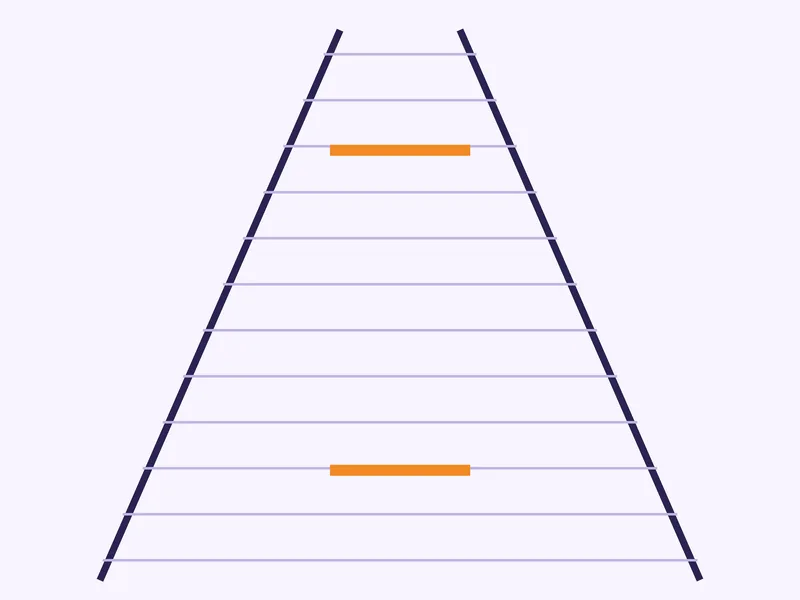
In the Ponzo illusion, a shape touching two converging lines looks bigger than an identical shape where the lines are further apart. Britannica: Illusion
Mario Ponzo’s 1911 paper turns out not to contain the famous Ponzo picture at all; it is mainly about an illusion of touch. Michael Bach: Size constancy
Size constancy: the brain’s distance correction
Britannica: the size of the image on the retina is one of the clues to distance; the larger the image, the closer we judge the object to be. Britannica: Space perception
Assuming size constancy, the visual system works out how big something is as its size on the retina multiplied by how far away it assumes it is. Michael Bach: Shepard’s “Subterranean Terror”
Size constancy is always at work. It is why someone walking away from you doesn’t seem to shrink into a dwarf. Michael Bach: Size constancy
Paste three identical cars along a bridge drawn in perspective, and they seem to grow the further away they are. Michael Bach: Size constancy Richard Gregory called this “inappropriate constancy”: the cars are pasted in flat, but the brain assumes they follow the perspective like everything else, and corrects for distance. Michael Bach: Size constancy
A 2021 review of Ponzo-like illusions found that a modernised version of Gregory’s explanation fits the experiments best. Michael Bach: Size constancy
Two famous pictures (go and see them)
Roger Shepard’s drawing of two identical monsters in a tunnel is a classic example of the Ponzo illusion: the two look very different in size. Michael Bach: Shepard’s “Subterranean Terror”
Roger Shepard drew his own illusions, and also invented the “ever rising scale”, a sound that seems to climb for ever. Michael Bach: Shepard’s “Turning the Tables” Shepard’s “Turning the Tables” shows two table tops that look completely different but are the same shape and size on the page. Michael Bach: Shepard’s “Turning the Tables”
These are Roger Shepard’s own drawings, so we haven’t copied them here: follow the links to see them on Michael Bach’s site.
Why distance fools you
Large, distant objects can look the same size as small, nearby ones. Exploratorium: Size and Distance (Science Snack) With one eye closed, your depth perception is much weaker, so you can’t tell how far away each coin is. Exploratorium: Size and Distance (Science Snack)
Next: the moon illusion →