The Müller-Lyer illusion
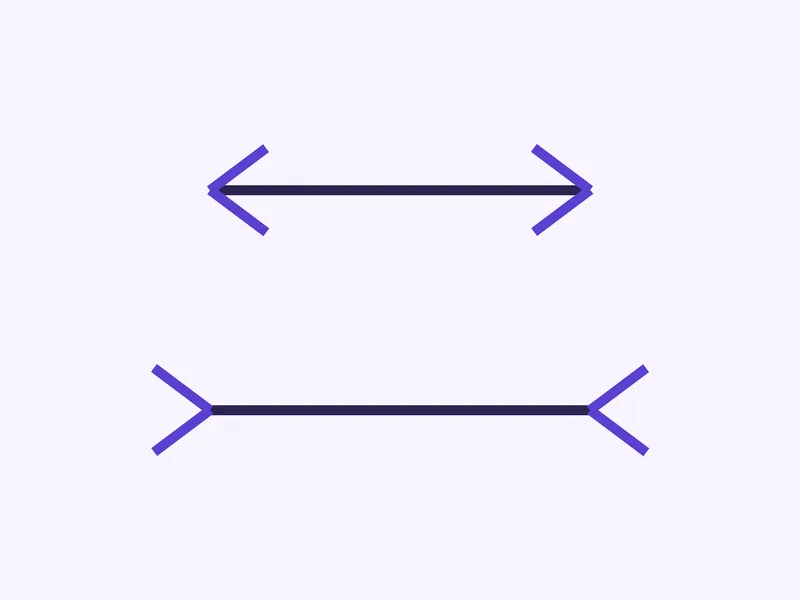
Two identical lines. Add some fins. Watch one of them grow. It’s the most famous size illusion of the lot, and nobody fully agrees why it works.
Where it came from
The Müller-Lyer illusion dates from 1889. Michael Bach: Müller-Lyer illusion Franz Müller-Lyer’s original figure was two double-ended arrows; the version with a single line split in the middle is Franz Brentano’s variant. Michael Bach: Müller-Lyer illusion
How big is the effect?
Asked to find the middle of the line in the Brentano version, big errors are completely normal: Michael Bach, whose illusion collection this comes from, says he is out by about 10%. Michael Bach: Müller-Lyer illusion
You can try it right now: Measure the Trick has a Müller-Lyer round, and it tells you your error to the nearest per cent.
Why does it work?
The corner idea
The perspective explanation (Richard Gregory, 1968): fins pointing in look like the near corner of an object, fins pointing out like the far corner of a room. Michael Bach: Müller-Lyer illusion
With no other clues, the brain takes the “angles in” line to be nearer and, because both lines throw the same-sized image, decides the nearer one must be shorter. Michael Bach: Müller-Lyer illusion
Michael Bach files the Müller-Lyer illusion under “size constancy”, because he finds the perspective explanation very convincing. Michael Bach: Müller-Lyer illusion
The “arrows lead your eye” idea
Britannica explains the Müller-Lyer illusion with the Gestalt ideas of convergence and divergence: the fins at the ends seem to lead the eye inwards or outwards, giving a false impression of length. Britannica: Müller-Lyer illusion
Still arguing
The perspective explanation has had critics (Segall and colleagues in the 1960s), and a 2025 paper by Amir and Firestone pushed back on the idea that the illusion is a product of culture. Michael Bach: Müller-Lyer illusion
The honest answer: there are good explanations, and scientists still test and argue about them.
It works on pictures too
Around 1970 the German satirical magazine Pardon ran a piece on the illusion, showing it works on whole pictures too: the elephant drawn in the bigger frame looked larger (and happier). Michael Bach: Müller-Lyer illusion
A cousin: the Jastrow curves
Müller-Lyer actually published the same illusion three years before Jastrow. Michael Bach: Jastrow illusion
The T, Jastrow and sine illusions →
The illusion drawings on this site are our own, drawn from scratch from the classic recipes (two lines, some fins, a ring of circles). Where a famous original belongs to its artist, such as Roger Shepard’s monsters, we describe it and link to it rather than copy it.