Size illusion experiments to try at home
A ruler, two coins, a sheet of clear plastic and one closed eye. That’s the whole lab.
1. The coin test
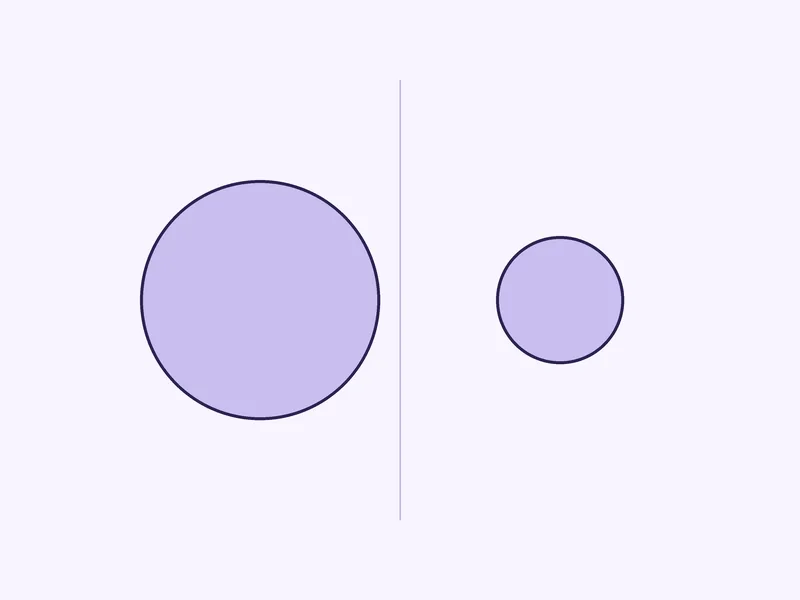
Close one eye and hold a small coin and a large coin at different distances: you can make them look exactly the same size. Exploratorium: Size and Distance (Science Snack) A bright, plain background works best, so the coins show up as silhouettes. Exploratorium: Size and Distance (Science Snack)
- Find a big coin and a small one.
- Close one eye and hold the small coin closer to you than the big one.
- Move them until they look exactly the same size.
- Now open both eyes and look again.
Large, distant objects can look the same size as small, nearby ones. Exploratorium: Size and Distance (Science Snack) With one eye closed, your depth perception is much weaker, so you can’t tell how far away each coin is. Exploratorium: Size and Distance (Science Snack) With both eyes open you get more points of view and judge size and distance much better. Exploratorium: Size and Distance (Science Snack)
2. The shoebox peep-show
The Exploratorium’s shoebox version mounts a quarter-sized and a dime-sized paper circle on straws, viewed through a hole with one eye. Exploratorium: Size and Distance (Science Snack)
In the Exploratorium’s museum version you look at two discs through a peephole; the smaller disc is always closer to you. Exploratorium: Size and Distance exhibit
3. The moon trace
The Exploratorium’s test: trace a rising full moon onto clear plastic held at arm’s length, then check again hours later. The high moon still fits the outline. Exploratorium: Looking at the moon
The moon’s image on a photograph is the same size whether it is low or high: the change happens in your brain. Exploratorium: Looking at the moon
4. The little-finger moon test
Test it: at arm’s length, about two-thirds of the width of your little finger covers the moon, wherever it is in the sky. Michael Bach: Moon illusion
5. The upside-down moon
Bend over and look at the moon between your legs, and the illusion gets much weaker. Michael Bach: Moon illusion
6. Measure the trick
- Draw two lines exactly 10cm long, one under the other.
- Add fins pointing in to one and fins pointing out to the other.
- Ask someone which is longer, then hand them the ruler.
- Try it on screen with Measure the Trick and write down your error.
The steps in experiments 1 and 6 are our own wording; the facts beside them link to their sources.
A trick from nature
A butterfly pupa has a pattern like a monkey’s face. It is only half as wide as a human fingernail, but birds seem to mistake it for a more distant, and so larger, monkey. Exploratorium: Size and Distance (Science Snack)