Why the moon looks huge on the horizon
It isn’t closer, it isn’t bigger, and the air isn’t magnifying it. The change happens behind your eyes.
What’s going on
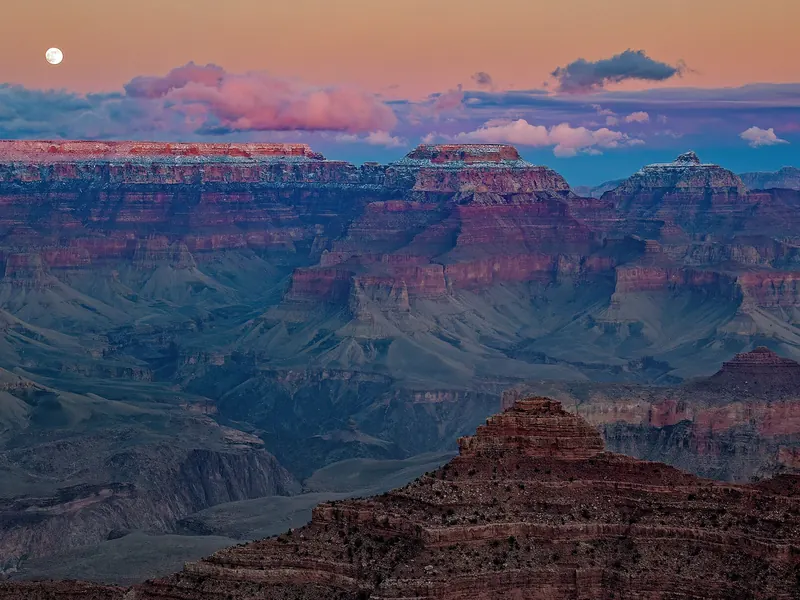
The moon illusion has two parts: the moon looks bigger than it really is, and much bigger near the horizon than high in the sky. Michael Bach: Moon illusion It isn’t just the moon: any object in the sky looks bigger near the horizon. Michael Bach: Moon illusion
The moon’s image on a photograph is the same size whether it is low or high: the change happens in your brain. Exploratorium: Looking at the moon
Prove it with your little finger
Test it: at arm’s length, about two-thirds of the width of your little finger covers the moon, wherever it is in the sky. Michael Bach: Moon illusion
The Exploratorium’s test: trace a rising full moon onto clear plastic held at arm’s length, then check again hours later. The high moon still fits the outline. Exploratorium: Looking at the moon
If anything, it’s a bit squashed
If anything, the low moon is a tiny bit squashed from top to bottom, because its light passes through more air near the horizon. Michael Bach: Moon illusion
Why does the brain do it?
Birds, clouds and planes are closer when overhead and further away on the horizon, so we expect things on the horizon to look small. The moon doesn’t shrink there, so it seems huge. Exploratorium: Looking at the moon
Hermann von Helmholtz credited the size-constancy explanation to Ptolemy. Michael Bach: Moon illusion
In 1962 Irvin Rock and Lloyd Kaufman tested the illusion with artificial moons and found the moon’s apparent size depends on whether you can see terrain. Michael Bach: Moon illusion
An old puzzle
Aristotle wrote that the sun and stars seem bigger when rising and setting; he blamed the air. Michael Bach: Moon illusion
Try the upside-down trick
Bend over and look at the moon between your legs, and the illusion gets much weaker. Michael Bach: Moon illusion
What about those giant moon photos?
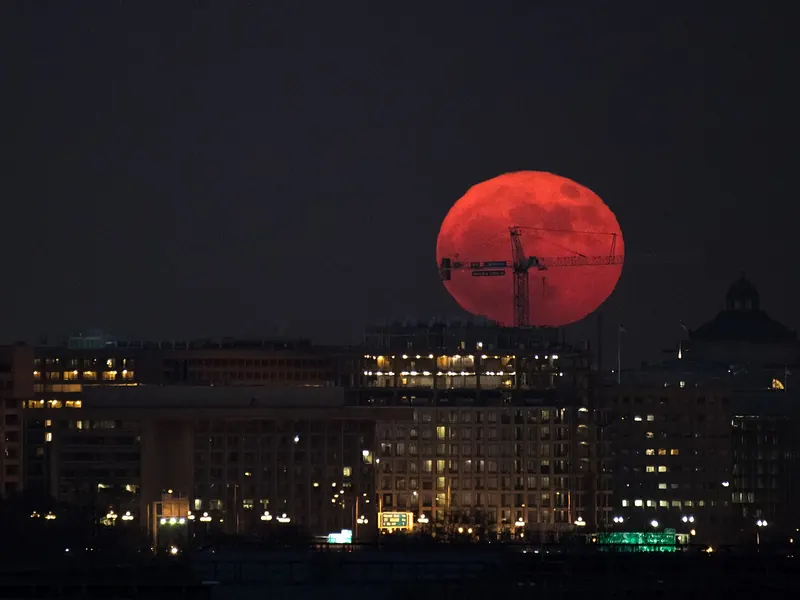
Photos of a giant moon behind a building are taken with a telephoto lens; that is a camera effect, not the moon illusion. Michael Bach: Moon illusion
The real moon does change a little
The moon is on average about 384,000 km (238,600 miles) from Earth. Britannica: Moon (natural satellite) The moon’s real size in the sky does change a little: its oval orbit brings it closer to and further from Earth. Britannica: Moon (natural satellite)
The sun is far bigger than the moon but also far further away, so the two look almost the same size in the sky. That is why total solar eclipses happen. Exploratorium: Size and Distance (Science Snack)

Next: the Ames room →