The Ames room: where people grow and shrink
Look through the peephole and it’s an ordinary room. Then someone walks across it, and goes from giant to tiny.
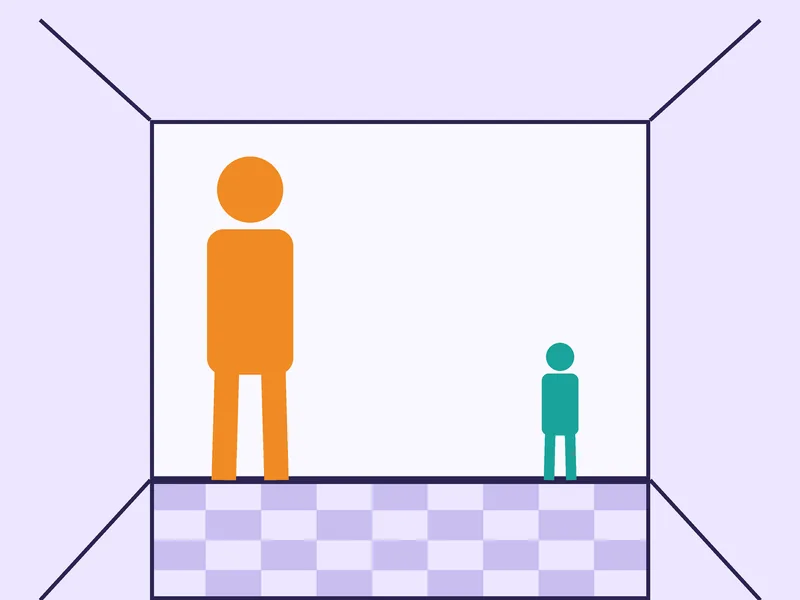
How it works
An Ames room looks like an ordinary square room from one peephole, but one side’s ceiling is about twice as high as the other. Exploratorium: Distorted Room Because the brain decides the room is square, people walking across it seem to grow and shrink. Exploratorium: Distorted Room
Who built it
Adelbert Ames Jr was born in 1880 and worked on visual sensation and perception; he is best known for the Ames room. Exploratorium: Ames Chair (Science Snack)
Ames and Egon Brunswik argued that we perceive under the strong influence of learned assumptions. Britannica: Adelbert Ames, Jr.
In the films
Film-makers have used Ames rooms for special effects: in The Lord of the Rings, some Shire scenes used them to make hobbits look tiny next to Gandalf. Exploratorium: Distorted Room
More of Ames’s tricks
The Ames window
The Ames window is a slowly turning trapezoid, the shape a rectangle would be if seen at an angle. As it turns, it seems to reverse direction partway round. Michael Bach: Ames window To see a real Ames window properly, close one eye so your two eyes’ depth clues don’t spoil the trick. Michael Bach: Ames window
Michael Bach sees the Ames window as a good example of the brain rebuilding the world from incomplete information, using experience: usually right, but easily misled by unusual shapes. Michael Bach: Ames window
The Ames demonstrations were written up by William Ittelson in 1952. Michael Bach: Ames window
The Ames chair
The Exploratorium’s Ames Chair is a jumble of bent stems on angled lines in a box. Through a peephole they line up into a chair. Exploratorium: Ames Chair (Science Snack)